She's Not Your Mom, But She'll Act Like It: The Unofficial Village Brown Moms Have Always Known
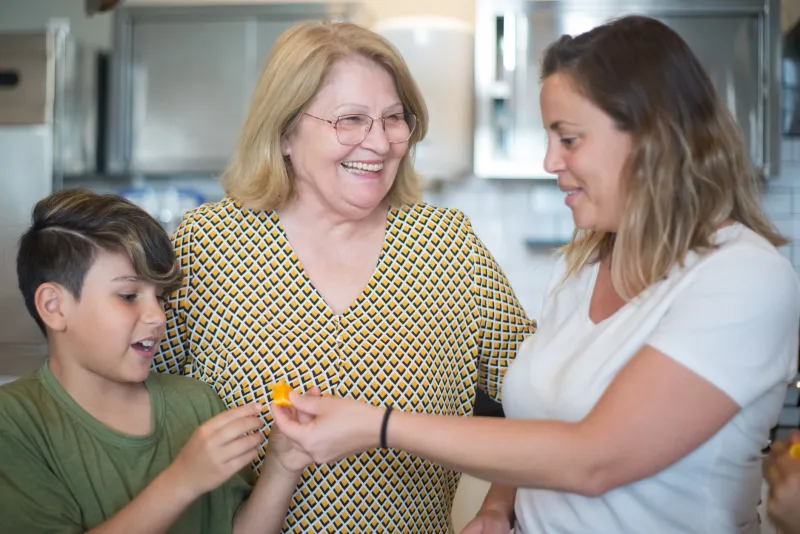
There's a moment every Brown mom knows. You walk into a family gathering — maybe a dinner, maybe an Eid, maybe just a random Sunday that somehow became a full-scale event — and before you've even set down the dish you brought, an aunty has already assessed your child's weight, your under-eye circles, and the fact that you look tired, beta. She means well. She always means well. And somehow, that makes it both better and worse at the same time.
Welcome to the Aunty Network. It has no membership fees, no group chat invite (though, actually, there are several group chats), and absolutely no opt-out button. But here's the thing nobody tells you when you're rolling your eyes at the unsolicited parenting commentary: this village has been showing up for Brown moms in ways that the curated, aesthetically pleasing "mom tribe" culture of mainstream America never quite manages to replicate.
What the Village Actually Looks Like
Let's be clear — this isn't the village from the inspirational Instagram quote. It doesn't show up in matching athleisure for a morning walk. It shows up at 7 p.m. on a Tuesday with a full pot of dal because it heard, through channels you will never fully understand, that you've been unwell. It shows up as a neighbor aunty who takes your kid for two hours without being asked because she could see through your window that you were on the phone crying. It shows up as a family friend who has known you since you were six and will, without question, watch your children while you go to a doctor's appointment — and also remind you to eat more ghee while she does it.
This is the informal infrastructure that so many Brown moms in the US have grown up inside of, and it operates on a completely different frequency than the playdate-and-coffee-shop version of community that gets celebrated in mainstream parenting culture. It's louder. It's more involved. It has opinions about your marriage, your cooking, and whether your child is spending too much time on screens. But it is, undeniably, there.
The Loneliness Nobody Talks About
Here's what's interesting: despite having this built-in network, a lot of Brown moms in America still report feeling profoundly lonely. And that's not a contradiction — it's actually a really specific kind of loneliness. It's the loneliness of being surrounded by people who love you deeply but don't always see you fully. The aunties know the version of you that fits neatly into the family story. They know your parents, your background, your kids' names and ages. But they might not know the part of you that's exhausted by the performance of it all, or the part that's quietly grieving a version of yourself you left behind somewhere between the second baby and the third career pivot.
Mainstream mom culture, for all its flaws, at least creates space for that kind of vulnerability. The mom Facebook groups, the parenting podcasts, the therapy-speak that has filtered into everyday conversation — there's an invitation there to say I'm struggling without it becoming community news by morning. The Aunty Network, bless it, is not always great at holding that kind of secret.
The Overstepping Is Actually the Point
But here's the reframe that took me a long time to get to: the overstepping? It's a feature, not a bug. When an aunty tells you that your kid needs a heavier coat or that you should be feeding them more iron, it's annoying, yes. It can feel infantilizing. It can make you want to lock the door and pretend you're not home. But it also means someone is paying attention. Someone is invested. In a country where new moms can go weeks without a real adult conversation, where the postpartum period can feel like being dropped into a void, where entire neighborhoods exist without people knowing each other's names — being known a little too well is actually a radical act of community.
The mainstream parenting world has spent the last decade trying to build what Brown moms have always had. There are apps for it now. Paid services. Entire business models built around the idea of "finding your village." And meanwhile, Brown moms have been navigating a village that was never a choice — it was just the condition of belonging.
Hiding From the Village (We've All Done It)
None of this means the Aunty Network is without its complications, and let's not romanticize it into something it's not. There are real reasons Brown moms sometimes hide from it. The commentary on weight, on parenting choices, on whether you're raising your kids with enough culture or too much of the wrong kind — it accumulates. The pressure to perform okayness in front of people who knew your mother can be its own kind of exhausting. Some aunties carry old wounds and older biases, and those don't disappear just because their intentions are good.
And for Brown moms who are navigating things that fall outside the traditional family script — divorce, mental health struggles, kids who are neurodivergent, identities that don't map neatly onto expectation — the village can sometimes feel less like a safety net and more like a spotlight. That's real, and it deserves to be named.
Taking What Works, Leaving What Doesn't
The modern Brown mom is, honestly, doing something pretty sophisticated here. She's learning to take what the Aunty Network offers — the food, the childcare, the bone-deep loyalty, the sense of being woven into something larger than yourself — while also building boundaries that her own mother probably never had language for. She's learning to say thank you for the advice, I'll think about it and mean neither part of that sentence. She's learning to let the village love her kids without letting it define them.
She's also, quietly, building something new. Group chats with other Brown moms who get it. Friendships that hold both the cultural fluency of the aunty world and the emotional openness of something more modern. A hybrid village, maybe — one that has the warmth of the old model without all the baggage.
The Village Isn't Perfect. It's Still the Village.
At the end of the day, the Aunty Network is imperfect in the most human way possible. It's made of real people who are doing their best with what they were given, who love in the language they were taught, who show up even when they don't know exactly how to help. That's not nothing. In a country where isolation is practically a public health crisis, that's actually quite a lot.
So yes, the aunty at the dinner party will have something to say about your kid's screen time. She will offer you a remedy for something you didn't ask about. She will know things about your family that you thought were private. And she will also, without hesitation, move mountains for you if you need her to.
That's the village. It's not aesthetic. It's not curated. But it's yours, and it has always been there — even when you were hiding from it.