Hustle Is Not a Personality: Why Brown Moms Deserve Rest Without the Resume
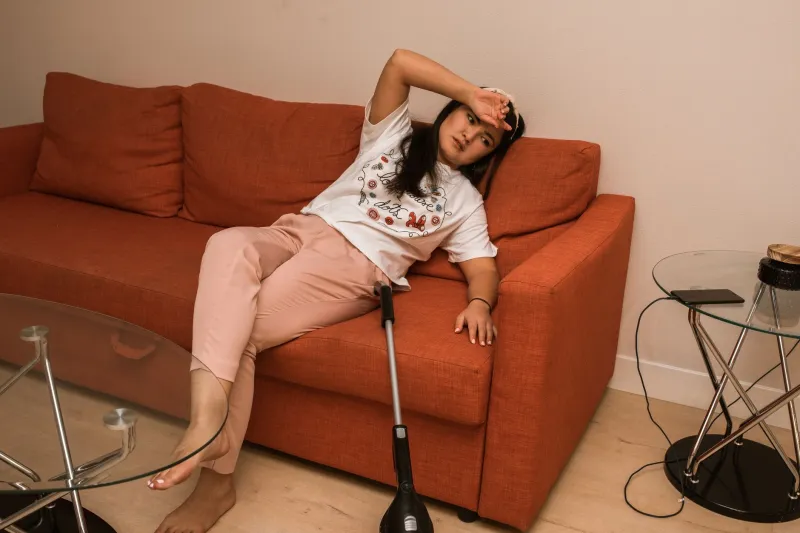
Somewhere between packing lunches, fielding work emails, and texting back your mother-in-law about Sunday dinner, you forgot to breathe. Not metaphorically — literally. You've been shallow-breathing through a to-do list since 6 a.m., and the wild part? You feel kind of good about it. Productive. Worthy. Seen.
That feeling has a name. And it's not ambition. It's survival dressed up in a planner.
For a lot of brown moms in the US, busyness isn't just a circumstance — it's a currency. We spend it constantly, trading hours of rest for proof that we're doing enough, being enough, worth enough. And most of us learned this exchange rate before we even became mothers.
Where This Comes From (Hint: It's Not Just You)
Let's be honest about the inheritance. Many of us grew up watching our own mothers move through the world like they had something to prove. They cooked from scratch after a full shift. They hosted family gatherings while nursing migraines. They never sat down first. And when they finally did sit, they brought something to fold, something to sort, something to do — because stillness felt dangerous.
In immigrant households especially, productivity wasn't just a virtue. It was a visa. It was the answer to every unspoken question about whether you deserved to take up space in this country, this neighborhood, this PTA meeting. You worked hard to justify your presence, and then you worked harder to make sure no one could question it.
That's the cultural root of it. And it runs deep.
But here's what nobody tells you: when you become a mother, that conditioning doesn't soften — it multiplies. Suddenly you're not just proving your own worth. You're performing productivity on behalf of your entire family, your heritage, your community's reputation. You become the living argument for why brown women can handle it all.
The Busyness Performance and Who's Watching
There's a particular kind of exhaustion that comes not from the work itself, but from narrating the work. You know what I mean. The way you mention how little you slept in casual conversation. The way you list everything you accomplished today before anyone asks. The way you feel a low-grade anxiety on a slow Saturday, like the absence of tasks is somehow suspicious.
This is busyness as performance. And the audience isn't always other people — sometimes it's the voice in your own head that sounds suspiciously like your nani.
Social media has made this worse, not better. We've replaced the aunties clocking your idle hands with Instagram feeds full of brown women who wake up at 5 a.m., meal prep for the week, run a side business, raise bilingual children, and still have time to post about gratitude. And instead of calling that what it often is — a highlight reel built on burnout — we use it as a measuring stick for our own days.
The result? Rest starts to feel like failure. Downtime starts to feel like laziness. And the brown mom who actually takes a nap on Sunday afternoon is quietly convinced she's falling behind.
What It's Costing You
Let's talk about the real price tag, because this isn't just about feeling tired.
Chronic busyness — the kind that's identity-driven rather than circumstance-driven — has a documented impact on mental health. Anxiety, depression, emotional numbness, and burnout don't announce themselves dramatically. They show up as snapping at your kids over small things. Crying in the car before you walk into the house. Feeling weirdly disconnected from the people you're working so hard for.
And then there's what it models for your children. When your kids grow up watching you treat rest like a reward you haven't earned yet, they absorb that lesson quietly and completely. Your daughter learns that women are supposed to be perpetually in motion. Your son learns that the person who loves him most is always just slightly out of reach, buried under a pile of tasks.
That's not the inheritance any of us want to pass down.
The Radical (And Honestly Pretty Simple) Alternative
Here's the thing about redefining rest — it doesn't require a wellness retreat or a complete life overhaul. It starts with a much smaller, much harder shift: deciding that you don't have to earn the right to stop.
Some brown moms are already doing this quietly, and it looks different for everyone.
It looks like a mom who tells her kids on a Sunday afternoon, I'm resting right now, I'll be available in an hour — and actually does it, phone face-down, no guilt spiral. It looks like a woman who stops prefacing her relaxation with an explanation of how hard she worked to deserve it. It looks like group chats where brown moms check in on each other not just with how are the kids but with did you do anything just for yourself this week?
It also looks like pushing back on the cultural script that says a woman's value is proportional to her output. That script was written in a different era, under different pressures, by people who were doing their best with what they had. You're allowed to revise it.
Rest Is Not the Opposite of Ambition
This is the reframe that a lot of us need. Rest isn't laziness. It isn't giving up. It isn't falling behind or letting people down. Rest is what makes everything else sustainable. It's the thing that lets you actually show up — present, patient, there — instead of just physically occupying the same space as your family while your brain runs its millionth lap around the to-do list.
Ambitious brown moms who rest strategically and unapologetically don't become less. They become more — more creative, more grounded, more connected to the actual point of all this effort.
You are not the sum of your productivity. You are not a list of things accomplished. You are a whole person, and whole people need rest the same way they need food and water and someone to tell them they're doing okay.
Let the Busy Season End
There will always be a reason to stay busy. A season that's especially demanding, a project that needs finishing, a family that needs more than you currently have to give. The busy season, if you let it, will never actually end — because that's what seasons do when you stop believing rest is allowed between them.
So maybe this is the moment. Not to do less, necessarily. But to stop using busyness as proof of your worth. To let a slow afternoon just be a slow afternoon. To sit down first sometimes, the way no one ever taught you.
You don't need to earn that seat. You already have it.