Dressed for Survival: How Brown Moms Are Rewriting the Rules of Looking 'Put Together'
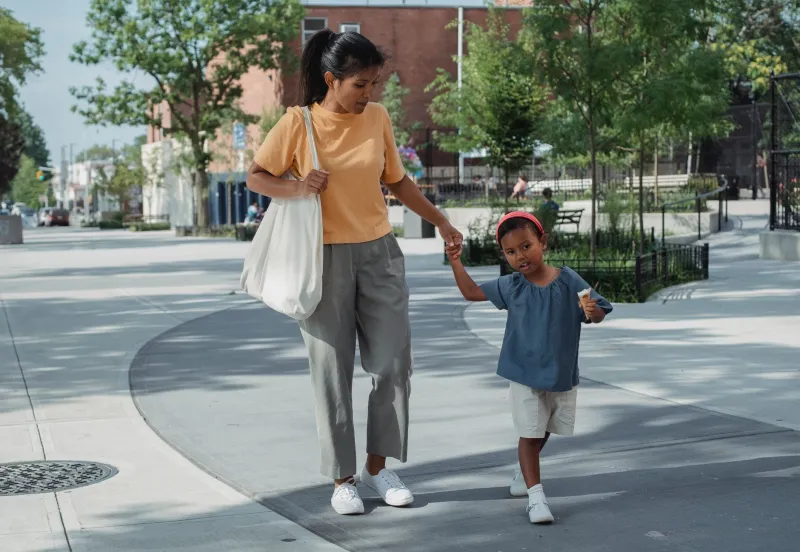
Let me paint you a picture. It's 7:43 in the morning. One kid can't find their left shoe. The other one just announced — just now — that today is pajama day at school. Your dupatta is somewhere near the couch. Your coffee has gone cold for the second time. And somewhere, in a parallel universe, a lifestyle influencer is posting a Reel about her "effortless morning routine."
Real brown mom life looks nothing like that Reel. And honestly? It never did.
We've spent years navigating a very specific kind of pressure — the kind that says you should show up looking composed, polished, and culturally appropriate all at once. Appropriate for the school parking lot. Appropriate for the aunties at the temple. Appropriate for the office Zoom call you're taking from the kitchen. It's a lot. And most of us have been quietly managing it without ever getting credit for the sheer logistical feat it represents.
So let's talk about it. Let's talk about what brown moms actually wear, why we wear it, and why the conversation around "mom style" has never quite fit us right.
The Myth of the Effortless Mom
Here's the thing about "effortless" style: it's never actually effortless. It's just effort that's been made invisible. And brown moms know this better than anyone.
We grew up watching our own moms perform this particular kind of magic — stepping out in a neatly pressed salwar, bindi perfectly centered, even after a full day of cooking, cleaning, and managing everyone else's everything. There was pride in that presentation. A quiet dignity. But there was also an enormous amount of invisible labor holding it all together.
Now we're the moms. And we're doing the same invisible math, except we've added careers, school pickups, cultural obligations, and the constant background noise of social media telling us we're doing it wrong.
The pressure to look "put together" isn't new for brown women. But the version of it we're navigating today has a few extra layers that our mothers didn't have to deal with — like algorithm-perfect aesthetics and the very American obsession with "athleisure as a personality."
What We Actually Wear (And Why It Makes Perfect Sense)
Ask a modern brown mom what she's wearing on any given Tuesday and the answer probably involves some combination of a dupatta she grabbed off the hook by the door, a cardigan that goes with everything, leggings that double as both loungewear and school pickup attire, and footwear that she can slip on and off a hundred times a day.
Is it a fashion moment? Maybe not by magazine standards. But is it functional, culturally grounded, and completely intentional? Absolutely.
The brown mom wardrobe has always been about versatility. A kurta that works for grocery runs and a quick visit to the mandir. A shawl that serves as a wrap, a cover-up, and a makeshift blanket for the kid who fell asleep in the back seat. Clothes that can survive a hug from a toddler with hummus hands and still look decent enough for an impromptu FaceTime with the in-laws.
This isn't laziness. This is engineering.
The Cultural Tug-of-War Nobody Talks About
There's a very particular tension that brown moms in America navigate around appearance that doesn't get discussed enough. On one side, there's the cultural expectation — often inherited, sometimes internalized — that a woman's presentation reflects on her family, her upbringing, her values. Looking disheveled isn't just personal; it's perceived as a statement.
On the other side, there's the very real, very exhausting reality of American mom life, which rewards the woman who shows up to soccer practice in a baseball cap and calls it a vibe.
We're caught in the middle, trying to honor both without fully belonging to either. And that middle space? It's where the brown mom uniform was born.
Some days that looks like a beautifully embroidered kurta with sneakers. Some days it's a Target cardigan and a gold jhumka earring because the earring does the heavy lifting. Some days it's whatever clean thing was closest to the door when the school bus honked.
All of it counts. All of it is valid.
Redefining Elegance on Our Own Terms
Here's what I want to say clearly, without apology: brown moms are not behind the trend. We are not aspirationally approaching some ideal of put-together-ness that we haven't quite reached yet. We are actively, intentionally redefining what elegance looks like — and it looks like authenticity.
Elegance is the mom who wears her grandmother's bangles to the pediatrician's office because they make her feel held. It's the woman who throws a bright chunni over her gym clothes because color is non-negotiable. It's the one who shows up in a full suit to her kid's school play because she came straight from a board meeting and didn't have time to change and she's not apologizing for either version of herself.
We are not a monolith. South Asian, Latina, Middle Eastern, Black — "brown mom" holds multitudes. But across those differences, there's a shared experience of being perceived as either too much or not enough, and learning to dress for ourselves in spite of that.
Comfort Is Not a Compromise
Somewhere along the way, comfort got coded as giving up. Like if you chose flat shoes over heels, you'd stopped trying. Like a stretchy waistband was a white flag.
Brown moms never bought into that fully — we've been wearing comfortable, practical clothing that also carries cultural weight for generations. The salwar kameez is comfortable. The anarkali is comfortable. The saree, when you know how to drape it, is comfortable. Comfort and beauty have never been mutually exclusive in our fashion vocabulary.
What we're doing now is just making that explicit. We're saying out loud what we've always known: dressing well doesn't mean dressing uncomfortably. Showing up doesn't require suffering. You can be fully yourself — tired, proud, culturally grounded, and absolutely not wearing heels to the school drop-off — and that is enough.
The Uniform Is the Message
If the brown mom uniform could speak, here's what it would say: I am managing more than you can see, and I am doing it with intention.
It would say: I honor where I come from, and I'm also building something new.
It would say: I don't need your approval to feel good in my own skin.
That's not a compromise. That's a philosophy. And it's one that the rest of the world — with its capsule wardrobe obsessions and quiet luxury aesthetics — is only just starting to figure out.
We've been here the whole time, in our kurtas and cardigans, gold earrings and sneakers, showing up, doing the work, and looking exactly right while doing it.
The uniform was never the problem. The standards were.