She Never Gave a Lecture, But She Taught You Everything: The Unspoken School of the Brown Mom
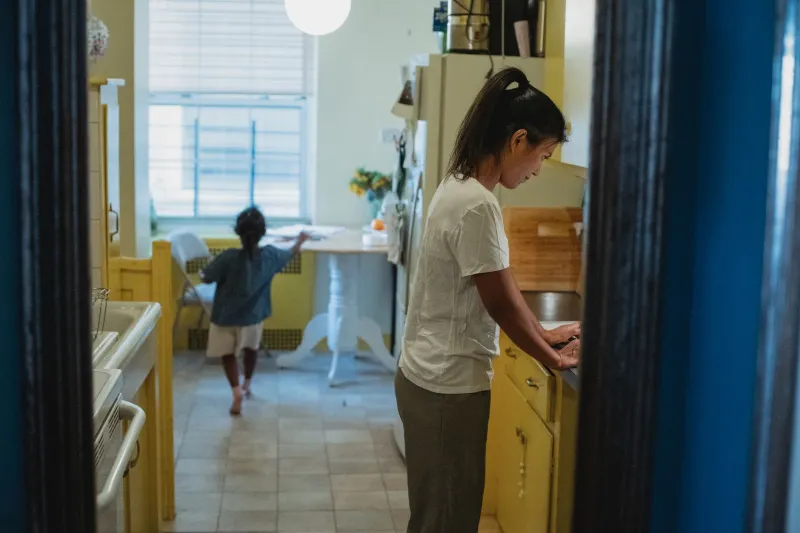
Your mom never sat you down and said, "Today we are going to discuss financial resilience." She never scheduled a seminar on navigating racism with grace, or booked a workshop on how to hold your head up when the world makes you feel small. And yet — somehow — you learned all of it.
That's the thing about brown moms. The most important stuff they teach us never gets said out loud.
There's a whole invisible curriculum running in the background of every brown household in America, and most of us don't even clock it until we're adults, standing in our own kitchens, doing the exact thing our mothers used to do and suddenly understanding why. It's not magic. It's modeling. It's sacrifice made visible. It's values communicated not through words, but through the ten thousand small choices a woman makes every single day.
And if you're a brown mom raising kids right now? You're already teaching this curriculum. You probably just don't realize it.
The Classroom Was the Kitchen Table
Let's start where so much of it actually started: at the dinner table, or on the couch watching the evening news, or in the car during school pickup. Brown moms teach through proximity. You didn't learn the value of hard work from a motivational poster — you learned it by watching your mother come home exhausted from a double shift and still make sure there was a hot meal on the table. You didn't learn financial prudence from a TED Talk. You learned it by watching her stretch a twenty-dollar bill across a week of groceries and somehow make it feel like abundance.
These weren't performances. She wasn't doing any of it at you. But you were watching, absorbing, filing it all away in some deep place that would only reveal itself decades later when you caught yourself doing the same thing.
Research in developmental psychology backs this up: children learn values far more effectively through observation and imitation than through direct instruction. What brown moms have always known intuitively, science eventually caught up to. The "do as I say, not as I do" approach? It doesn't work. Kids are watching what you do. Always.
Resilience Wasn't a Lesson. It Was a Lifestyle.
Ask any brown mom in America about adversity and she'll probably laugh — not because it's funny, but because the list is long and she's made peace with most of it. Immigration paperwork. Workplace discrimination. Being the only brown face in the room. Raising kids in a culture that constantly asks them to choose between who they are at home and who they're expected to be everywhere else.
She didn't sit her kids down and explain how to handle all of that. She just... handled it. And her kids watched.
They watched her code-switch in professional settings without losing herself. They watched her field microaggressions at parent-teacher conferences and walk out still dignified. They watched her cry privately and show up publicly, every single time. What they absorbed wasn't a lesson plan — it was a blueprint. A lived demonstration of what it looks like to bend without breaking.
That's not a small thing. In a country that still regularly asks brown families to prove their belonging, teaching your children that they can withstand pressure and keep going? That might be the most important thing you ever pass down.
What She Did with Money Taught You More Than Any Finance Class
Brown mom money culture is its own entire discipline, and it is wildly undervalued in mainstream parenting conversations. The coupons. The bulk buying. The refusal to throw anything away that could be repurposed, reused, or remade into tomorrow's lunch. The way she tracked every dollar without ever using a budgeting app because the math was already running in her head constantly.
Kids who grow up in brown households often develop an almost instinctive relationship with financial caution. They know what it feels like to want something and wait for it. They understand that money represents security, not just spending power. They've watched their mothers treat savings not as optional but as survival.
None of this comes from a conversation. It comes from years of watching someone navigate scarcity with dignity — and sometimes, with a creativity that honestly borders on genius.
Respect as a Practice, Not a Rule
Every brown kid in America has heard some version of "respect your elders" — but the actual teaching of respect didn't happen through that phrase. It happened through watching mom greet every auntie with warmth even when she was exhausted. It happened through seeing her make time for phone calls to grandparents, show up to community events, remember birthdays, and extend hospitality to people who showed up unannounced at inconvenient times.
Respect, in the brown mom's invisible curriculum, is not a rule you follow. It's a practice you embody. And children raised in that environment don't just understand the concept intellectually — they feel it in their bones. They grow up knowing that relationships require maintenance, that elders carry wisdom worth honoring, and that community is something you show up for, not just something you belong to.
Recognizing the Curriculum Changes Everything
Here's why this matters for brown moms raising kids right now: when you don't recognize the invisible curriculum you're running, you can't be intentional about it. You can't decide which lessons you want to pass forward and which generational patterns you'd rather retire.
Maybe your mom's version of financial caution tipped into anxiety, and you want to teach resourcefulness without the scarcity mindset. Maybe her version of respect for elders came with a side of silence that you don't want to replicate. Maybe her resilience was real and admirable, but it also meant she never asked for help — and you're actively trying to teach your kids a different model.
Naming the curriculum gives you agency over it.
It also gives your kids something incredibly valuable: a framework for understanding themselves. So many first and second-generation brown kids grow up feeling like their values are just different from their peers without being able to articulate why. When you can say "here's what I was teaching you, and here's where it came from" — even if you say it years later, even if you say it imperfectly — it connects the dots for them in ways that matter.
You're Already Teaching. The Question Is What.
Every brown mom reading this is already running her own invisible curriculum. You're teaching your kids something every time you handle a hard phone call in front of them, every time you choose to rest instead of grinding, every time you advocate for yourself in a room that wasn't built with you in mind.
You don't have to be perfect. You don't have to be consistent. You just have to keep showing up — which, honestly, is probably the most important lesson of all.
The classroom is wherever you are. And your kids are always in session.