Half Hindi, Half English, Wholly Brilliant: The Case for Your Kid's 'Messy' Language
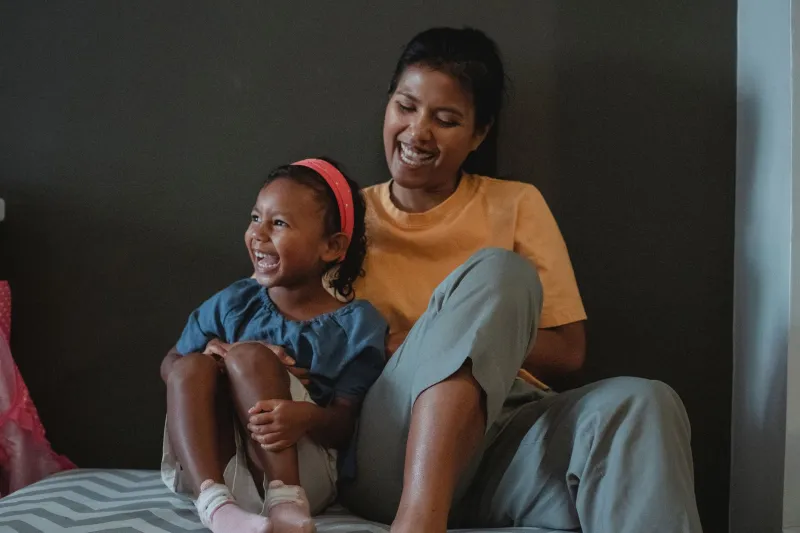
Let me paint you a picture.
Your seven-year-old is on the phone with Nani, confidently telling her about her day — in a language that is approximately 40% Gujarati, 40% English, and 20% something only the two of them seem to understand. She switches mid-sentence without even blinking. Nani laughs. Your daughter laughs. And then you hang up and spend the next ten minutes quietly worrying that you've somehow failed her. That she should be speaking properly. That her language is broken.
Same, sis. Same.
But here's the thing: that worry? It's misplaced. Because what your daughter just did on that phone call is something most kids in this country literally cannot do — and researchers are increasingly calling it a cognitive superpower.
What's Actually Happening When Kids Mix Languages
There's a name for what our kids do. Linguists call it code-switching — the fluid, often unconscious movement between two or more languages within a single conversation, or even a single sentence. For brown kids growing up in the US with heritage languages at home, this isn't a bug. It's a feature.
When your son drops a Tamil word into an otherwise English sentence because the English word just doesn't fit the feeling — that's not laziness. That's sophisticated linguistic judgment. He has two entire language systems running in his brain simultaneously, and he's choosing, in real time, which one better serves the moment. That's not a gap. That's a skill.
And the science backs this up in ways that should make every brown mom want to frame the research and hang it next to the family photos.
The Brain Benefits Nobody Told Us About
Decades of research on bilingualism have consistently shown that kids who grow up navigating more than one language develop stronger executive function — the set of mental skills that includes attention control, cognitive flexibility, and working memory. These are the same skills that help kids focus in a noisy classroom, switch between tasks without melting down, and think through problems from multiple angles.
But here's where it gets even more interesting for our specific kids: children who code-switch regularly — who don't just know two languages but actively toggle between them — may be getting an even more intense mental workout than kids who keep their languages neatly separated. Every time your kid decides whether to say "gharwale" or "family," their brain is doing a tiny, rapid-fire exercise in categorization, context-reading, and decision-making.
Mono-lingual kids, no matter how bright, simply don't get that workout.
'But She's Losing the Language'
This is the fear that keeps brown moms up at night, isn't it? That the mixing means forgetting. That if she's saying "can we go ghar now" instead of a full Hindi sentence, she's slipping away from the culture, from the family, from something we can't get back.
It's a real concern, and it deserves honesty rather than dismissal. Heritage language maintenance is genuinely hard in a country where English dominates everything from school to screens to friendships. And yes, there is a difference between a child who code-switches within a heritage language and one who has mostly lost access to it.
But mixed language use — the hybrid, the Hinglish, the Tanglish, the Gujarlish, whatever you're working with in your house — is not the same as language loss. In fact, linguists often see it as evidence that the heritage language is alive in a child's brain, actively competing for space rather than sitting silent and forgotten.
The kid who has no Punjabi left doesn't mix Punjabi into their English. They just speak English. The mixing? That's the language fighting to stay in the conversation.
Third-Culture Kids Have Always Done This
Our children belong to a long, global tradition of kids who grew up between worlds. Third-culture kids — those raised in a culture different from their parents' origin — have always developed their own linguistic and cultural hybrids. It's how cultures survive migration. It's how identity gets rebuilt across generations.
The Spanglish that's been spoken in Latino communities across the US for generations isn't considered broken Spanish anymore — it's recognized as its own vibrant, rule-governed dialect. The same evolution is happening with the languages our kids speak. "Hinglish" isn't a mistake. It's an emerging form of expression with its own internal logic, its own grammar patterns, its own cultural fingerprint.
When your kid speaks it, they're not failing at two languages. They're succeeding at a third one that belongs entirely to their experience.
What We Can Do (Without the Pressure)
None of this means we stop trying. We can still read them books in our mother tongue. We can still insist on certain words being said the "right" way. We can still call Nani regularly so the language has somewhere to live outside our four walls. We can still play the old Bollywood songs and let the lyrics sink in without explanation.
But we can do all of that without the shame spiral. Without correcting every mixed sentence like it's a grammar test. Without treating their natural, creative, functional use of language as evidence of our failure as mothers.
Because here's the truth: you gave your child a heritage language in a country that had zero interest in helping you do it. You did that while working, while managing a household, while navigating your own identity questions, while trying to make sure they also thrived in English-speaking classrooms and friendships and spaces.
That they speak any of it — mixed, imperfect, hybrid, gloriously chaotic — is not a small thing. That is an enormous thing.
The Real Flex
The next time your kid seamlessly shifts from English to Tamil to explain something to your mother-in-law, and your mother-in-law actually understands, I want you to notice that moment differently. Don't see the gaps. See the bridge.
Your child is the bridge. Between your parents and your present. Between the country you came from and the one you're building a life in. Between a culture that could have been lost and one that's still — messily, beautifully, imperfectly — alive.
That's not broken language. That's a whole superpower, right there at your dinner table, asking for thoda more rice.
Let them have it.