Not the Recipes, Not the Language: What You're Actually Leaving Behind
I used to have a running list in my head. A sort of informal curriculum of things I needed to make sure my kids knew before they grew up and left my house. The language, obviously. At least a functional version of it. The major religious holidays and what they mean. How to make a few key dishes from scratch. The names of relatives three generations back. The stories about where we came from.
I called it, privately and a little dramatically, my cultural transmission plan.
My kids called it "Amma's random quizzes."
And here's what I've come to understand after years of both enforcing and quietly abandoning that list: most of it doesn't stick the way I imagined. And the things that do stick? I never once put them on the list.
The Weight of What We Think We Need to Pass Down
There's a particular kind of pressure that lives inside the chest of a brown mom raising kids in America. It's the pressure of being a bridge. Of knowing that you are, in a very real sense, the last generation to hold certain things close — certain words, certain smells, certain ways of moving through the world — before they start to fade.
So we overcompensate. We sign kids up for heritage language school on Saturday mornings when they would rather sleep in. We insist on attending every cultural festival within a two-hour radius. We correct pronunciation with a little too much urgency. We hover over the stove narrating our cooking like we're filming a documentary nobody asked for.
None of this is wrong, by the way. The impulse comes from love. From grief, even — a preemptive mourning for things we're afraid to lose.
But it can also become a kind of performance. A checklist of cultural boxes that we're frantically ticking, hoping the sum of them adds up to children who know who they are.
What My Kids Will Actually Remember
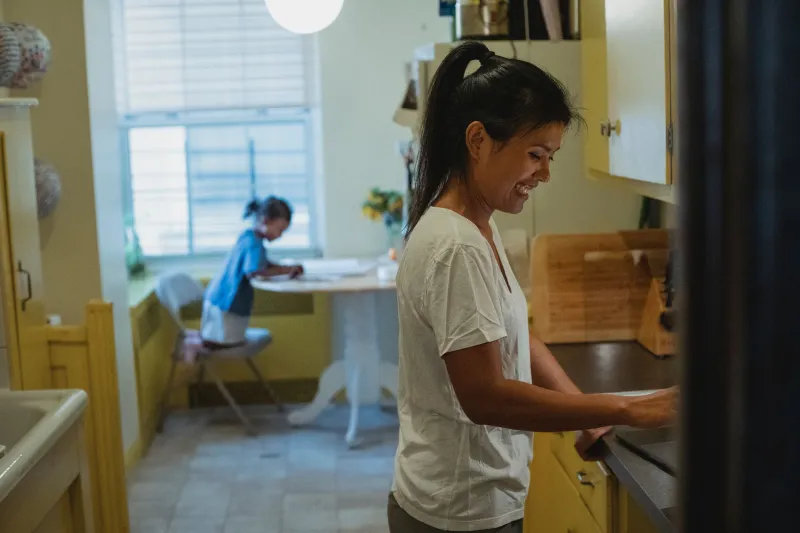
My daughter is eleven. Last year, completely unprompted, she told me that her favorite sound in the whole world was the sound of me cooking in the morning before everyone woke up. The clink of the pressure cooker. The sizzle of cumin in hot oil. She said it made her feel safe.
She cannot, for the record, tell me what cumin is called in our mother tongue. She has approximately forty words of functional Gujarati and uses them mostly to make her cousins laugh. She has never once asked me to explain the significance of Navratri.
But she knows what safety sounds like. And she learned it from me, in a kitchen, before sunrise, without me ever intending to teach her a single thing.
This is the invisible inheritance. The stuff that seeps in through the walls.
The Moments That Shape Them (That Have Nothing to Do with Culture)
Here's a list of things my children are absorbing from me right now, completely outside of any intentional cultural curriculum:
The way I handle disappointment. Whether I fall apart quietly or whether I regroup and keep going. The way I talk about other women — with generosity or with judgment. Whether I apologize when I'm wrong, and whether I do it quickly or after a long, stubborn delay. The way I treat the cashier at the grocery store. Whether I rest without guilt or whether I treat rest like a reward I haven't yet earned.
These are not brown mom things. They're human things. But they are the truest things I will ever pass down, because they're not things I can fake or schedule or put on a curriculum. They just are me. And my kids are watching.
Letting Go of the Perfect Cultural Transmission
Somewhere along the way, I made peace with the fact that my children's relationship to our culture will not look like mine. It will not look like my mother's. It will be something new — a hybrid thing, shaped by growing up between two worlds, fluent in neither and somehow at home in both.
That used to scare me. Now it mostly fascinates me.
My son makes his own version of chai that involves oat milk and way too much sugar and he is enormously proud of it. Is it authentic? Absolutely not. Is it his? Completely. And the fact that he makes it at all — that he reaches for that specific comfort when he's tired or sad or wants to feel at home — means something. It means he has a relationship with that ritual, even if it looks nothing like the one I was handed.
That's not failure. That's how culture actually survives. Not perfectly preserved, but adapted. Carried forward in forms the original version never anticipated.
The Spoiler Nobody Tells You
Here it is, the thing the headline promised: what your kids will actually remember is not the festival you dragged them to when they were eight. It's not the language worksheets. It's not even the recipes, although — fingers crossed — maybe a few of those.
What they will remember is your laugh. Specifically, the one that catches you off guard and becomes a little too loud and embarrasses them in public right now but will become one of their most treasured sounds in twenty years. They will remember the way you showed up for them on the hard days, and the specific words you used when you didn't know what to say but said something anyway. They will remember that you tried. Not perfectly. Not according to plan. But consistently, stubbornly, lovingly.
They will remember that you were a whole person — not just a mother, not just a keeper of traditions, but a woman with a history and a sense of humor and opinions and a way of moving through the world that was entirely your own.
And they will carry pieces of that with them forever, whether they can name it or not.
Keep Teaching, But Hold It Loosely
None of this means you should abandon the Saturday language classes or stop making the biryani from scratch or give up on getting them to the temple more than twice a year. Keep doing those things. They matter. They are seeds, and some of them will take root in ways you won't see for decades.
But don't let the checklist become the whole story. Don't let the pressure of perfect cultural transmission steal the smaller, quieter moments — the ones happening right now, in ordinary Tuesday kitchens and long car rides and bedtime conversations that go longer than they should.
Those moments are the inheritance. They always have been.
You're already leaving behind exactly what matters. You just might not be able to see it yet.